Every digital business eventually runs into the same question: how does the money move?
Fintech is only 1% finished.
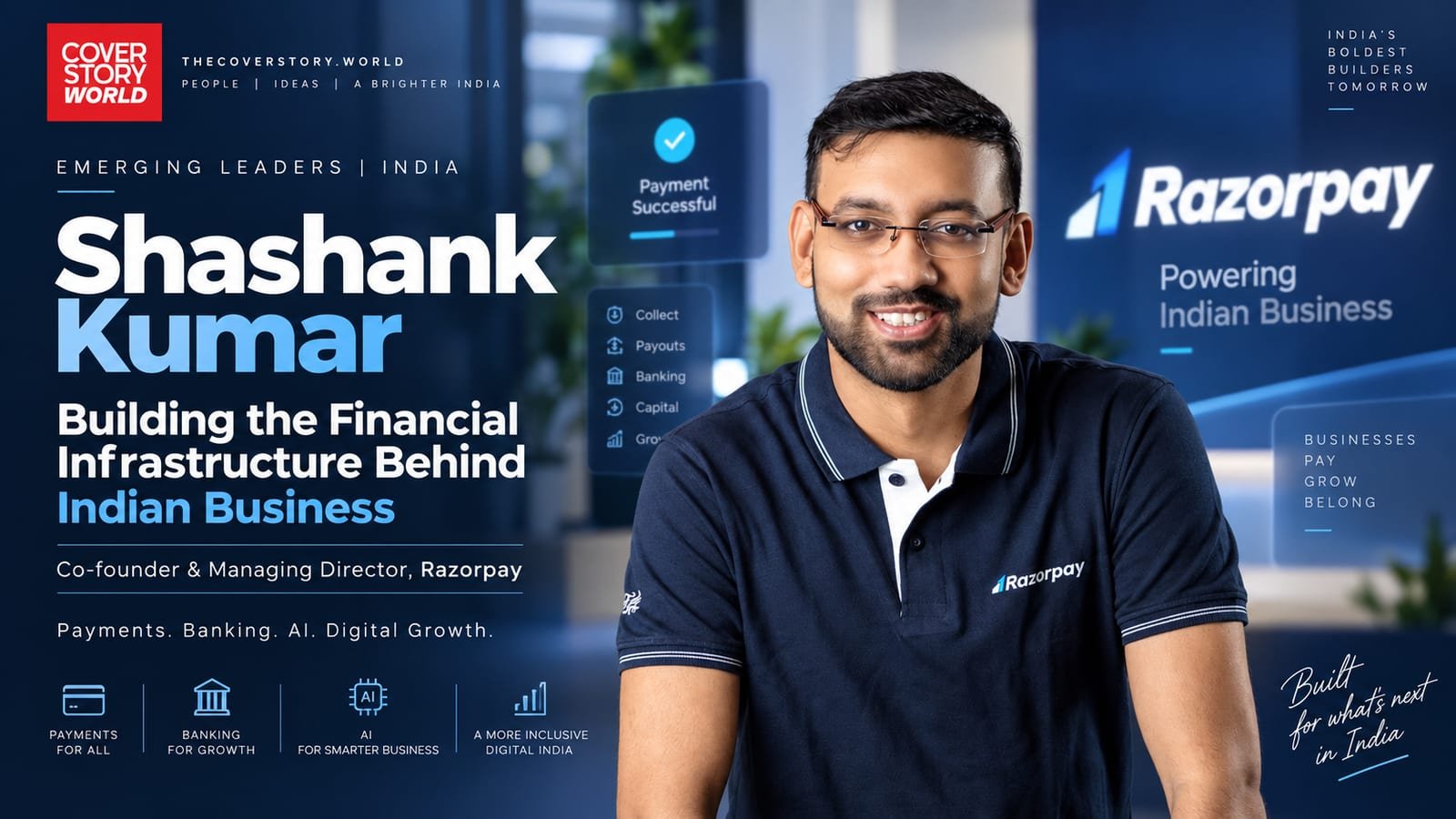
For Shashank Kumar, that question became the foundation of Razorpay.
What began in 2014 as an effort to simplify online payments for Indian businesses has evolved into something much larger — a financial infrastructure company operating across online payments, point-of-sale transactions, cross-border commerce and business finance.
Kumar, an IIT Roorkee alumnus, co-founded Razorpay with Harshil Mathur and helped build the company through Y Combinator at a time when India’s startup ecosystem was still considerably smaller and payment infrastructure was far more fragmented.
The opportunity they saw was straightforward.
Businesses were becoming digital faster than the financial systems supporting them.
Razorpay set out to close that gap.
From Payment Gateway to Business Infrastructure
The original Razorpay proposition was simple: make accepting online payments easier for developers and businesses.
But that was only the beginning.
As Indian companies grew more sophisticated, their financial problems expanded beyond checkout.
They needed payouts. Payroll. Banking workflows. Working-capital solutions. International payments. Physical payment acceptance. Financial automation.
Razorpay followed the customer deeper into each of those problems.
That evolution has changed the company’s identity.
It is no longer useful to think of Razorpay merely as a payment gateway.
Increasingly, it is building the financial operating infrastructure behind businesses.
For Kumar, that expansion reflects a broader belief: financial technology works best when businesses do not have to think constantly about the complexity underneath it.
The infrastructure should simply work.
Connecting Online and Offline Commerce
One of Razorpay’s more important recent developments has been the expansion of its regulated payments footprint.
In January 2026, Razorpay POS received Reserve Bank of India approval for its offline payment-aggregator operations.
With authorisations spanning online, offline and cross-border payment aggregation, Razorpay has strengthened its ability to support businesses across multiple forms of commerce.
That matters because the distinction between online and offline retail is disappearing.
A consumer may discover a brand on social media, buy through an app, return a product at a store and make the next purchase through a payment link.
Businesses increasingly need a financial layer capable of following that entire journey.
Kumar’s opportunity is to make Razorpay that layer.
AI Moves Into Business Finance
The next transformation may be even more significant.
Artificial intelligence is moving rapidly from customer-facing applications into the financial operations of businesses.
Razorpay has begun embedding AI directly into that environment.
In 2026, RazorpayX introduced an agentic connected-banking platform designed to let businesses use AI agents across tasks such as payouts, collections and cash-flow management.
The shift is important.
Traditional business banking is built around dashboards, menus and manual processes.
Agentic finance moves toward a world in which businesses can increasingly instruct systems what they want done — and let software execute the workflow.
For Kumar, this is a natural extension of Razorpay’s original philosophy.
First, remove friction from payments. Now, remove friction from financial operations themselves.
Helping Indian Businesses Sell to the World
Razorpay is also widening its focus beyond domestic commerce.
Indian businesses are increasingly selling globally, but international checkout remains one of the biggest points of friction for exporters.
Razorpay has been expanding access to globally familiar payment experiences, including integrations supporting international transactions through major digital wallets.
The strategic objective is clear: an Indian company should not lose a customer simply because its payment infrastructure feels unfamiliar or inconvenient.
For Kumar, that makes cross-border payments more than a feature.
It becomes part of a larger ambition to give Indian companies financial infrastructure comparable with the best available anywhere in the world.
The Builder Behind the Platform
Kumar’s leadership profile is distinctive because his career has remained deeply connected to product and technology.
He is not simply the commercial face of Razorpay.
His public commentary consistently returns to building — better systems, better products and better financial experiences for businesses.
That engineering mindset is visible in the way Razorpay has evolved.
Instead of remaining concentrated around one successful product, the company has repeatedly expanded into adjacent financial problems.
That approach carries risk.
Every additional layer adds operational complexity, regulation and competition.
But it also creates the possibility of something far more valuable than a standalone fintech product: a financial platform businesses become increasingly dependent on as they grow.
“Fintech Is Only 1% Finished”
One of Kumar’s more telling observations is his belief that fintech is still at the beginning of its development.
It is an unusually ambitious idea for an industry that has already transformed how India pays.
UPI, digital wallets, online checkout and fintech lending have fundamentally changed financial behaviour.
Yet Kumar’s argument is that much of the financial infrastructure businesses use remains unnecessarily complex.
The next wave will therefore be less about digitising transactions and more about making finance intelligent, automated and responsive.
AI-powered payments. Automated banking. Smarter fraud prevention. Global commerce. Financial systems that increasingly adapt in real time to what businesses need.
If that vision materialises, the next decade of Razorpay may look considerably different from the first.
The Cover Story View
Shashank Kumar belongs to a generation of Indian founders whose companies have grown alongside the country’s digital economy.
But Razorpay’s story is particularly interesting because much of its impact is invisible.
Consumers see the brand they are buying from.
Businesses see the transaction.
Behind both sits infrastructure that has to work instantly, securely and repeatedly.
That is the business Kumar chose to build.
The next challenge is larger.
Razorpay must evolve from being an important fintech company into something closer to the financial technology layer on which businesses operate.
Payments were the entry point.
AI, connected banking, omnichannel commerce and global money movement are widening the opportunity.
If Kumar and Razorpay succeed, their greatest achievement may not be creating another major Indian technology company.
It may be making the financial machinery behind millions of businesses almost disappear.
Know a brand or leader like this? Nominate them for Asian Premier Brands and Leaders 2026. Entries close 16 October 2026.
Nominate

 Rashed Ahmadyar · Ahmadyar Developments